









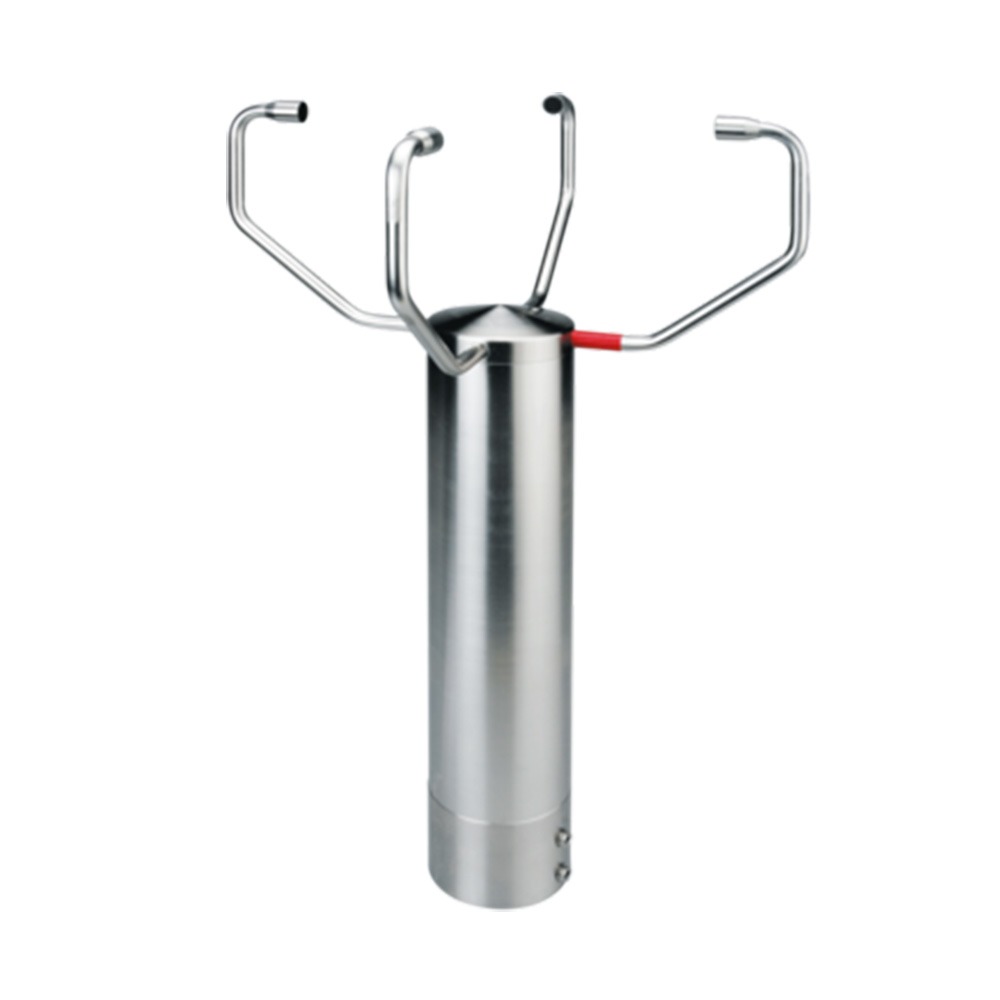
Range of application
The Ultrasonic Anemometer 2D is designed to acquire the horizontal components of wind velocity and wind direction as well as the virtual temperature. Due to the high measuring rate, the instrument is ideal for the inertia free measurement of gusts and peak values. The accuracy of the air temperature measurement (virtual temperature) surpasses that one of the classic method where the temperature transmitter is used in a weather and thermal radiation shield. The measured data are available as analogue signals or as a data telegram via a serial interface. The sensors as well as the instrument body are automatically heated, in case of critical ambient temperatures. Thus, the function is guaranteed even in case of snowfall or freezing rain, and the risk of icing is extensively avoided.
Mode of Operation
The Ultrasonic Anemometer 2D consists of 4 ultrasonic transformers in pairs of 2, which are opposite each other at a distance of 200 mm. The two measurement paths thus formed are perpendicular to each other. The transformers act both as acoustic transmitters and acoustic receivers. The respective measurement paths and their measurement direction are selected via the electronic control.
When a measurement starts, a sequence of 8 individual measurements in all 4 directions of the measurement paths is carried out at maximum speed. The measurement directions (acoustic propagation directions) rotate clockwise, first from south to north, then from west to east, north to south and finally from east to west.
The mean values are formed from the 8 individual measurements of the path directions and used for further calculations. A measurement sequence takes approx. 2,5 msec at +20°C.
Measurement principles
The speed of propagation of the sound in calm air is superposed by the velocity components of an air flow direction. A wind velocity component in the direction of the propagation of the sound supports the speed of propagation, thus leading to an increase in the speed. A wind velocity component opposite to the direction of propagation, on the contrary, leads to a reduction of the speed of propagation. The speed of propagation resulting from the superposition leads to different propagation times of the sound at different wind velocities and directions over a fixed measurement path.
As the speed of sound is very dependent on the air temperature, the propagation time of the sound is measured on both of the measurement paths in both directions. In this way, the influence of the temperature dependent speed of sound on the measurement result can be eliminated. By combining the two measuring paths, which are at right angles to each other, one obtains the measurement results of the sum and the angle of the wind velocity vector. Afterwards, one receives the angle and the sum of the wind velocity by transformation into polar coordinates.
As previously mentioned, the speed of the propagation of sound is highly dependent on the air temperature, but is hardly affected by air pressure and humidity. Thus, these physical properties of gases can be used to measure air temperature. As this is a measurement of gas temperature which is made without thermal coupling to a measurement sensor, it is called the "virtual temperature". The advantages of this measured variable is, on the one hand, its inertia-free reaction to the actual gas temperature, and, on the other, the avoidance of measurement errors such as those which occur when a solid state temperature sensor is heated up by radiation.
With air temperature measurement by a measuring sensor in a weather- and thermal radiation shield, measurement errors occur in outdoor environments. When the shield is warmed up by sun irradiation, the measuring values are too high, and they are too low following evaporation cooling with rain and wind. The measuring errors of those thermometers in practice can be up to ± 2°K. In this context, the 2D-Anemometer achieves a measuring accuracy of ± 1°K over the entire temperature range from 40°C to + 70°C, thus offering a very precise determination of the air temperature without the disadvantages caused by the use in a weather and thermal radiation shield.

Contact us
Just send us an email

Shipping
Send us an email for shipping options

Secure Checkout
Payments are via a secured platform